From Trunk to Carry-On: How Luggage Changed the Shape of Travel
From trunk to carry-on, luggage reflects how a journey is handled. Match your bag to its transfers, surfaces and storage, and pack with less friction.
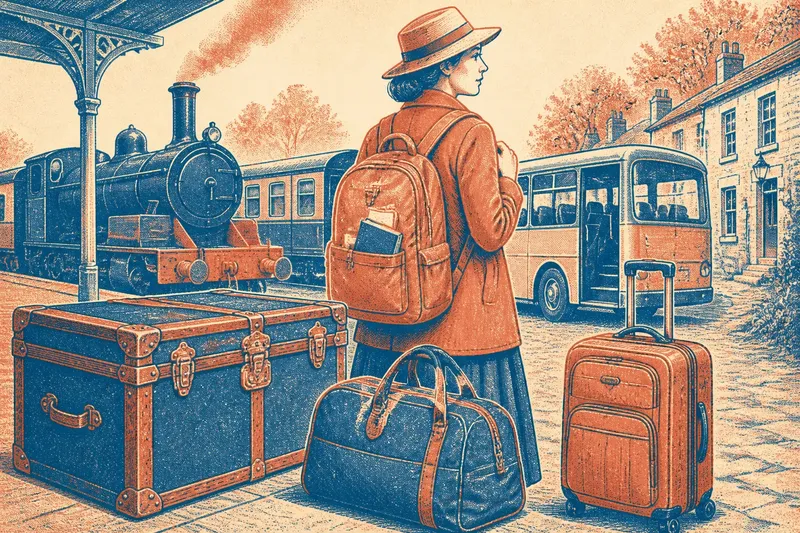
A trunk is awkward to carry through a station; a compact case can stay beside its owner on a coach. From trunk to carry-on, luggage offers a practical way to think about how travellers manage belongings across different journeys, without treating the past as a single straight march towards smaller bags.
Trunks suited journeys with separate handling
For an imagined earlier trip, Ada packs clothes, shoes and wrapped belongings into a large wooden trunk. It is firm and roomy, but cumbersome to lift through a crowded station. Its design makes most sense when the traveller can hand it over for transport or have help moving it.
A trunk separates packing from carrying: belongings are loaded at home, sent along, then collected and unpacked at the destination. That arrangement may suit a long stay, but it is less convenient if the traveller must repeatedly lift the container between platforms, vehicles and rooms.
Trunks were not the only option, and their use varied with the journey, available transport and personal circumstances. Rather than claiming that all travel once depended on porters or fixed stops, it is more useful to see a trunk as one response to a trip where capacity and protection mattered more than personal portability.
Portable cases suited journeys with more personal handling
Now imagine Ada taking a smaller case from a station platform to a coach, then carrying it up to her room. A handle and a manageable shape matter because she expects to move the case herself at each transition.
Portable cases did not simply replace trunks. A larger container can suit belongings sent ahead or a settled stay; a smaller case can suit a route where the traveller keeps luggage close. The choice depends on how much the traveller carries and who, if anyone, handles it along the way.
Wheels changed the balance between rolling and lifting
In another invented version of Ada’s trip, she pulls a wheeled case along a smooth station concourse. Rolling can make that stretch easier to manage, but it does not remove the need to lift the case at stairs or keep it close in a crowded aisle.
Soft-sided bags can be easier to fit into irregular spaces, while structured cases offer a firm shape around their contents. Neither is automatically better: the useful choice depends on the bag’s load, the route’s surfaces and the storage available on each leg.
Carry-ons keep belongings close to the passenger
A carry-on keeps a smaller selection of belongings with the traveller during the journey. It needs to be manageable in the passenger’s space and suited to the storage provided by the carrier. Rules differ, so check the relevant carrier’s current size and handling requirements before travelling.
Imagine Ada’s invented coach trip with a soft-sided carry-on, a coat and a book. She puts the book in an outside pocket, keeps the coat easy to reach and packs only clothes for her short stay. The expected result is a bag she can lift and keep nearby; the trade-off is less room for extra belongings.
How should luggage match the journey?
Why might someone choose a trunk?
A trunk may suit a trip where belongings can be transported separately and there is space to store a large container at the destination. If the traveller must lift luggage through many transfers, a smaller bag may be easier to manage.
When is a wheeled case useful?
A wheeled case can help on smooth, open stretches such as a station floor. If the route includes stairs, rough paving or tight aisles, choose a bag that can also be lifted and held close.
Should I choose a backpack or a carry-on case?
A backpack keeps the load on the wearer and leaves hands free, while a carry-on case may make it easier to separate and reach packed items. Consider the route, your comfort and the storage available, then check the carrier’s rules and the maker’s guidance where relevant.
Check the route before choosing a bag
Before packing, note where the bag must be lifted, rolled, stored or carried close. Each observation points to a decision:
- Observation: The route has several stairways. If you can comfortably lift the packed bag, a compact case may work; if not, choose a lighter load or a bag you can carry securely.
- Observation: Most of the route has smooth, open flooring. If the case’s wheels suit that surface, a wheeled case may help; if not, choose a bag that is easy to carry.
- Observation: The vehicle’s storage space is limited. If your bag fits the carrier’s current rules, keep it; if not, repack into an accepted bag or arrange another suitable option.
- Observation: You need frequent access to a coat, ticket or book. If the bag has an accessible pocket, use it; if not, pack that item near the top or carry it separately.
- Observation: The journey includes narrow aisles or crowded platforms. If the bag stays close to your body, it may be manageable; if not, choose a narrower bag or reduce what you carry.
- Observation: The stay is settled and the destination has room for a larger container. If you need the extra capacity and can arrange its transport, a trunk or larger case may suit; if not, pack a smaller bag for the actual stay.
Say Ada’s invented route starts at a station, continues by coach and ends with a walk over uneven paving to a small lodging house. She lists three needs: carry the bag herself, keep a book accessible and manage the final walk. She selects a compact backpack, places the book in its outer pocket, and leaves spare shoes at home; the expected result is one bag that can be carried through the walk without relying on wheels, with less choice of footwear as the trade-off. The decision could change if the coach has restrictive luggage rules, so she checks those before leaving.
It is not worth buying elaborate organisers for a journey with few transfers, or choosing a bag for an imagined trip that is not yours. Start with the actual route and belongings, then choose luggage you can handle comfortably. From trunk to carry-on, the useful question is not which form is newest, but which one fits the way you will move.